
Bihar Police arrested 141 people in a state-wide crackdown on mule bank account networks allegedly used for cyber fraud. The operation, 'Cyber Prahar 2.0', led to the registration of 86 FIRs and uncovered collusion by bank employees.

Only bona fide victims would be compensated by banks within five days of receiving the complaint.

Kanpur police have uncovered a GST fraud racket where suspects used unsuspecting individuals' documents to create fake firms and route transactions worth nearly Rs 250 crore.

Two chartered accountants have been arrested by the Enforcement Directorate in connection with a money laundering case linked to a cyber fraud involving Rs 641 crore.

A senior citizen in Navi Mumbai was allegedly swindled of 64 lakh over four years by cyber fraudsters posing as insurance regulators and grievance officials.

Delhi Police have arrested two individuals involved in an investment scam where a local resident was cheated of Rs 1.60 lakh. The investigation has linked the accused to a broader cyber fraud network with transactions worth approximately Rs 68 lakh across multiple states.

A software engineer earning a high salary allegedly abandoned his career to run a fake online trading racket, duping investors of nearly Rs 100 crore.

Police in Lucknow have arrested four people for allegedly using ChatGPT and graphic design software to create and sell fake IPL tickets outside the Ekana Stadium.
A 28-year-old man from Ghaziabad has been arrested for allegedly defrauding a Delhi woman of over Rs 1.51 lakh under the guise of a job application scam.

Delhi Police arrested a 22-year-old woman for allegedly providing mule bank accounts to an interstate cybercrime network, recovering numerous ATM cards, cheque books, and electronic devices.

Delhi Police have arrested five individuals for allegedly abducting and robbing a man after luring him through a dating application in the Kalkaji area. The victim was assaulted, forced to transfer money, and later abandoned.

A 64-year-old man from Thane was allegedly defrauded of 1.56 crore by cybercriminals using a 'digital arrest' scam, involving forged documents and constant surveillance.

Mastercard and Visa are introducing passkeys that will allow users to authenticate card payments with face scans or fingerprints, eliminating the need for one-time passwords (OTPs).

Cyber threats aren't always invisible -- sometimes they're right beside you.
This is the time of year to be most on guard against a host of scams, new and old.

UPI has catapulted India into the forefront on the global digital payments landscape. Working hand in hand, the AePS payments system is making life easy for rural folks, notes Tamal Bandyopadhyay.

The transition to UPI-based ATMs will be gradual, and consumers will not immediately switch to using standalone UPI ATMs overnight.

The number of cyber crimes in India could touch 3,00,000 in 2015

Finance Minister Nirmala Sitharaman on Tuesday asked fintech firms to focus on risk management at a time when criminals are using AI to mimic voices, clone identities and create lifelike videos to manipulate people.

The war between hackers and banks over ATM security will be dynamically redefined, notes Atanu Biswas.

The Reserve Bank on Thursday asked banks to provide the option of Interoperable Card-less Cash Withdrawal (ICCW) at their ATMs, a move aimed at curbing frauds like skimming, card cloning and device tampering. Currently, cardless cash withdrawal through ATMs is offered by a few banks for their customers at their own ATMs (also known as on-us basis). "All banks, ATM networks and WLAOs (White Label ATM Operators) may provide the option of ICCW at their ATMs," the central bank said in a circular.

The number of cyberfraud cases has skyrocketed from 2,677 in 1999-2000 to 29,082 in FY24 -- more than a 10-fold increase. The RBI pegs digital payment frauds at Rs 1,457 crore in FY24, up more than five times in a year. It's not just the number of frauds. What's alarming is the growing sophistication of the fraudsters, exposing the vulnerabilities within the financial system, observes Tamal Bandyopadhyay.
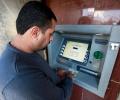
In a bid to check fraud, the Reserve Bank on Friday decided to permit all banks to introduce card-less cash withdrawal through ATMs.
To educate customers on the modus operandi of financial fraudsters and share inputs on safe banking habits, banks are now coming up with awareness campaigns aimed at preventing customers from falling into the trap of fraudsters.

The Central Bureau of Investigation (CBI) conducted searches at seven locations across India in connection with a Rs 350 crore crypto ponzi scam. The accused, operating seven modules in different cities, allegedly lured investors with promises of high returns on cryptocurrency investments. The CBI seized digital virtual assets totaling USD 38,414 in cryptocurrency wallets, cash amounting to Rs 34.2 lakh, and digital evidence, including mobile phones, laptops, tablets, hard disks, and memory cards. The agency registered the case under the Indian Penal Code and the Information Technology Act.

The survey was based on the survey of 44 banks.

About 70 per cent of ATMs in India are running on outdated operating systems, which makes it easier for fraudsters to crack them

In 2023-2024, 95 scheduled commercial banks received over 10 million complaints from their customers. The process of KYC at many banks has become 'HYC' -- harass your customer, points out Tamal Bandyopadhyay.

India recorded 50,035 cases of cyber crime in 2020, an 11.8 per cent surge in such offences over the previous year, according to the National Crime Records Bureau (NCRB) data. The Reserve Bank of India (RBI) last week once again cautioned bank customers of fraud, including those in Know-Your-Customer (KYC) cases. In fact, certain frauds have become more prevalent than others, and being aware of them is the first step towards protect yourself. Mayur Joshi, chief executive officer, Indiaforensic.com, a company engaged in the prevention, detection, and investigation of frauds says, "It is necessary to learn, to read about these scams."
A report Tuesday from Gartner Inc., a technology analyst firm, estimates that 3 million US consumers were victims of ATM and debit-card fraud in the past year.

With debit cards of 5 banks compromised, time to be very cautious while transacting. If possible, avoid non-bank ATMs.

Pawan Kumar Soni, a 55-year-old farmer based in Sri Ganganagar City in Rajasthan, became a victim of a cyber fraud when his 26-year-old son Harsh Vardhan opened a link from a phishing message that flashed on his mobile phone.

It is suspected that the electronic device at the ATM counter enabled the fraudsters to collect the secret pin code and card details.

The move will help curb card frauds. Currently, customers use only personal identification number for automated teller machine transactions.

The cash crunch following demonetisation and transaction fees that do not cover costs are among the reasons why the sector is struggling.

With about 2,000 qualified engineers to service ATMs across the country, it is an uphill task to modify 220,000 machines.

Off-site ATMs are set up on a standalone basis.

At times, banks violate all banking norms, resulting in a customer's accounts wiped clean through illegal ATM withdrawals.

Protect yourself and minimise such frauds by following these simple rules
Plastic counterfeiting and frauds have increased at an alarming rate. So how do you protect yours from being misused?
